There is a particular feeling you get when somebody on a screen, somebody who has never heard your name, starts describing your life back to you. Not your industry. Not your job title. Your actual Tuesday.
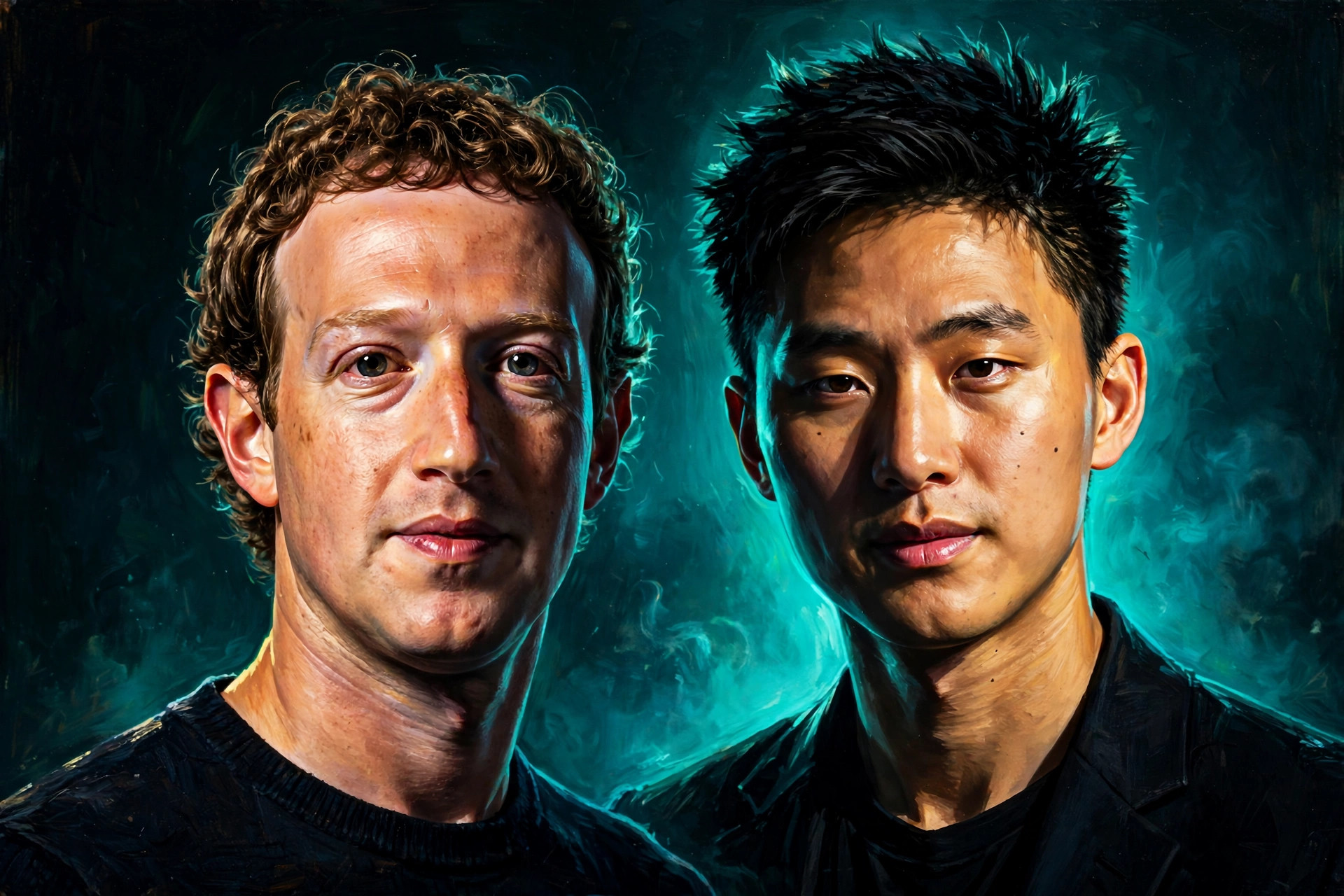
Mark Zuckerberg sat down with Cleo Abram in 2024 and described a generation that is coming. He talked the way builders talk when they are sure the road bends where they say it bends: calmly, like a man reading weather he helped make.
Wang sat down with her too, in another conversation, and described the same future from the other end of it. Not the inventing of it. The working in it. The part where the future stops being a keynote and starts being a shift you have to cover.
Two men. Two interviews. Neither has ever set foot in my studio. Between them, they described my workday so closely that I heard both conversations the way you hear your own name in a crowd. Your head turns before you decide to turn it.
At this studio, that future is not a prediction. It is not a trend piece, and it is not a someday. It is the workday, and it has been from the first day.
This article is the long version of that sentence. It covers what those two men said, what it looks like when it is running in a real shop in El Segundo, and why the part that matters most is not the part anybody puts on a stage.
DESCRIBE IT, AND IT'S BUILT
Start with Zuckerberg's picture, because it sounds like science fiction until you have lived inside it.
Kids, he said, will be able to just describe the things that they want, and build incredibly complex pieces of software from the description. Not learn three languages first. Not apprentice for a decade. Describe the thing, and the thing gets built.
He was not guessing from the sidewalk. He had done a version of it himself: described a thing for a few minutes, and a whole virtual world existed where before there was nothing. A few minutes of talking, and then a place, standing there, that had not existed when he started the sentence.
He put that future twenty years out. Or, in his own words, a lot sooner.
Hold that phrase for a second. A lot sooner. Here is how work actually starts at Frederick Studios, on a morning so ordinary it would bore a documentary crew.
I describe what needs to exist. In plain words, out loud or in a message, the way I would explain it across a counter to somebody standing in front of me. A page that needs to live on a website. A fix that needs making before a client sees the problem. A piece of video that needs to exist by tomorrow. I do not write the code. I do not design the layout. I do not run the production. I describe the thing: what it is for, who it is for, what it needs to feel like when it lands. And a team that knows my business builds it.
Work comes back the same day. I read it on my phone, wherever I happen to be standing. I change the word that is not right. There is almost always one, and finding it is my job, not a flaw in the system. I approve the rest with a tap, and it goes out into the world.
That was true on our very first day. On launch day, two websites went live, our own and a client's, because that is how the place was built to run from the start: a person describes, a team builds, the thing exists. It was not a stunt and it was not luck. It was the design, working on day one the way it was drawn. It is still true on an ordinary weekday now, which is the part nobody believes until they watch it happen twice.
Describing is not the shortcut around the work. At this studio, describing IS the work. The judgment inside the description, what belongs, what does not, what good looks like for this business and this customer, is what makes the built thing any good. A description is a decision wearing plain clothes.
Zuckerberg described that for kids, someday. Owners can use it now. He knew it, too, because in the same interview he read out a checklist that should stop every small business owner mid-scroll.
THE NEW LINE ON THE LIST
Every business, he said, is going to have an AI, the way it already has a website, a phone number, an email address, and a social media account. An AI that talks to your customers, helps you sell, helps you support the people who already bought from you.
Read that list again, slowly. Website. Phone. Email. Social.
For thirty years, that was the whole checklist, the price of being a real business that people can reach. Every item on it had its season of being the new thing somebody swore was optional. Every shopkeeper alive has heard some version of it: we have done fine without one of those. And every item, in turn, stopped being optional and became the price of admission. The list is how a business says: we are here, we are real, you can reach us.
AI is the new line on the list.
Not someday as a science project. As a line item, like the others, with one difference that changes everything: this one answers back.
When a customer asks a question at nine at night, it answers in your voice, with your prices, your hours, your way of doing things. Not a generic voice. Yours. When you are under a car, up a ladder, or elbow-deep in the lunch rush, your business is still being minded by something that knows it, still answering the way you would if you had a free hand and a free minute, which at nine at night and during the rush, you do not.
That is not a vision we are waiting on. Building that new line for small businesses is, plainly, what this studio does.
But a line on a list does not say what the thing actually is, day to day, hour to hour. A checklist cannot tell you what it feels like to work next to it. For that, listen to Wang.
THE GENERAL MANAGER
Wang's picture of AI is not a gadget. It is a hire.
He frames AI as a general manager for a small business. Sit with how different that is from everything else on the shelf. Not an app. Not a tool you poke at when you remember it is there. A manager. And he takes it one step further, all the way out to a "general manager... of your life."
Anybody who has run a small business knows what a good general manager is, because a good one is the difference between an owner who sleeps and an owner who does not. A general manager holds the whole operation in their head at once. They know which questions come in every single day and answer them the way the owner would, so faithfully that customers cannot tell the difference and mostly do not care. They know the regulars, the rhythm of the week, the thing that always breaks on Fridays. They keep the place running, steady and unremarkable, while the owner does the work that only the owner can do.
Wang has a plain phrase for that whole job: "clear the way." The manager clears the way, so the owner's hours go to the owner's work. Not to the inbox. Not to the third repetition of the same question. To the work.
That is the new line on Zuckerberg's list, given a job title and a set of keys. Not software waiting to be opened. A manager who minds the business.
Which raises the fair question, the one every owner asks the first time they hear this, and they are right to ask it.
CONTEXT IS THE DIFFERENCE
Isn't that just a chatbot?
No. The reason is the most useful thing in Zuckerberg's interview, worth more than every prediction in it put together. Asked what makes AI actually personal, he kept coming back to one word: context. An AI that knows nothing about you can only sound like it knows nothing about you. The one that works is the one that holds the context: your life, your business, your history, what is happening around you right now.
That is true of a manager, too, in exactly the same way. A general manager who knows nothing about your business is just a stranger with a title and a nice shirt. The one who works knows where everything is, how you like it done, and why you like it done that way.
That is why ours is built the way it is. Not one generic assistant rented off a shelf, answering everybody's customers the same way in the same flat voice. A system built around one business: its voice, its customers, its rules, its history, directed by its owner.
An AI that knows your business will beat a smarter one that does not, every day of the week, for the same reason a longtime employee beats a brilliant stranger on their first shift. The stranger may be smarter. It does not matter. The longtime hand knows where everything is, knows how you like it done, knows the customer who needs a call instead of a message. Smarts can be hired by the hour. Knowing a place cannot.
Context is the product. Everything else is typing.
MEMORY IS A DISCIPLINE
Now the honest part, and credit to Wang for saying it out loud, because almost nobody selling in this space will: he concedes that agent memory is not human-like.
He is right, and any owner should hear that plainly before buying anything in this space. The machine does not remember the way a person who has stood behind your counter for ten years remembers. It does not remember the way the regular takes their order, or that the Tuesday delivery driver needs the back gate open, or the sound a longtime customer makes when something is wrong. That kind of memory lives in people. Anybody who tells you a system has it is selling you something.
So here is our answer, and it is the opposite of a sales pitch. At this studio, memory is a discipline, not a feature.
The record gets kept. The business's voice, its customers, its rules, its history: written down, kept current, kept straight. Not because a feature promised to remember, but because keeping the record is part of the work, the same way a good manager's notebook is part of the work. Every good general manager any of us ever met kept a notebook, real or mental, and the notebook is why the place ran the same on their day off as it did when they were standing in it.
It is slower than magic. It also holds up. A manager is only as good as what the business actually knows about itself, and a business knows what somebody bothered to keep. Write it down, keep it straight, and the system standing at your counter at nine at night answers from the real record of your business, not from a guess.
THE CALCULATOR RULE
Zuckerberg said one more thing, and I hope every owner hears it, because it is the reassurance under all of this.
He still wants kids to learn to code. Not for the typing. For the thinking. Coding teaches rigorous thought, and he called it this generation's version of the calculator: you use the tool, and you also learn to be able to do without it.
Owners, that is us, word for word. Directing AI well is not a lesser skill than doing every task by hand. It is a different muscle, the judgment muscle, and most owners have been training it their whole working lives without ever naming it. Knowing your business cold. Knowing what good looks like before you can say why. Knowing which word is wrong on the page, and which customer needs you personally, today, not a message, not a manager, you.
The tools do not grow that muscle for you, and they were never supposed to. Those are your 500,000 pixels: the part of the picture only you can truly compute, the part no system will ever render for you. They stay yours. The tools just finally give your judgment some leverage, so one owner's good calls can cover the whole shop instead of expiring at the edge of their own two hands.
You stay the director. That is not a limitation of the design. That IS the design.
PRESENCE, NOT REPLACEMENT
Late in his interview, Abram put the hard numbers on the table, and they are the numbers this whole article has really been about. People spend far less time together in person than they used to. The average person, Zuckerberg noted, would like to have ten close friends, and has two or three.
And in Wang's interview, Abram named the mission underneath his work in four words: "giving people time back."
Two men. Two interviews. One destination. Strip away the headsets and the keynotes and the stock prices, and the point of all this machinery is time, and the point of the time is people. It always was. The technology is just the newest way of owing each other hours and finally paying some of them back.
Good technology does not replace the people in the room. It adds back what distance and workload took away. It does not sit at the dinner table. It keeps you from missing dinner.
That is the only kind we build. A system that answers the routine question at nine at night so the owner is not answering it from the dinner table, phone glowing next to the plate. A week that gets built from descriptions, so the hours come back: for the customers at the counter, for the family at home, for the town outside the door. The hours were always the product. Everything else is machinery.
They described the future, on camera, as something coming, twenty years out or a lot sooner.
We are already working in it, in a real studio, in El Segundo, for real businesses, today. Not as a demonstration. As a Tuesday.
So here is the question, pointed at you one more time: what is the first thing you would describe?
Tell us. We'll show you it built.
Proof, not promises.