
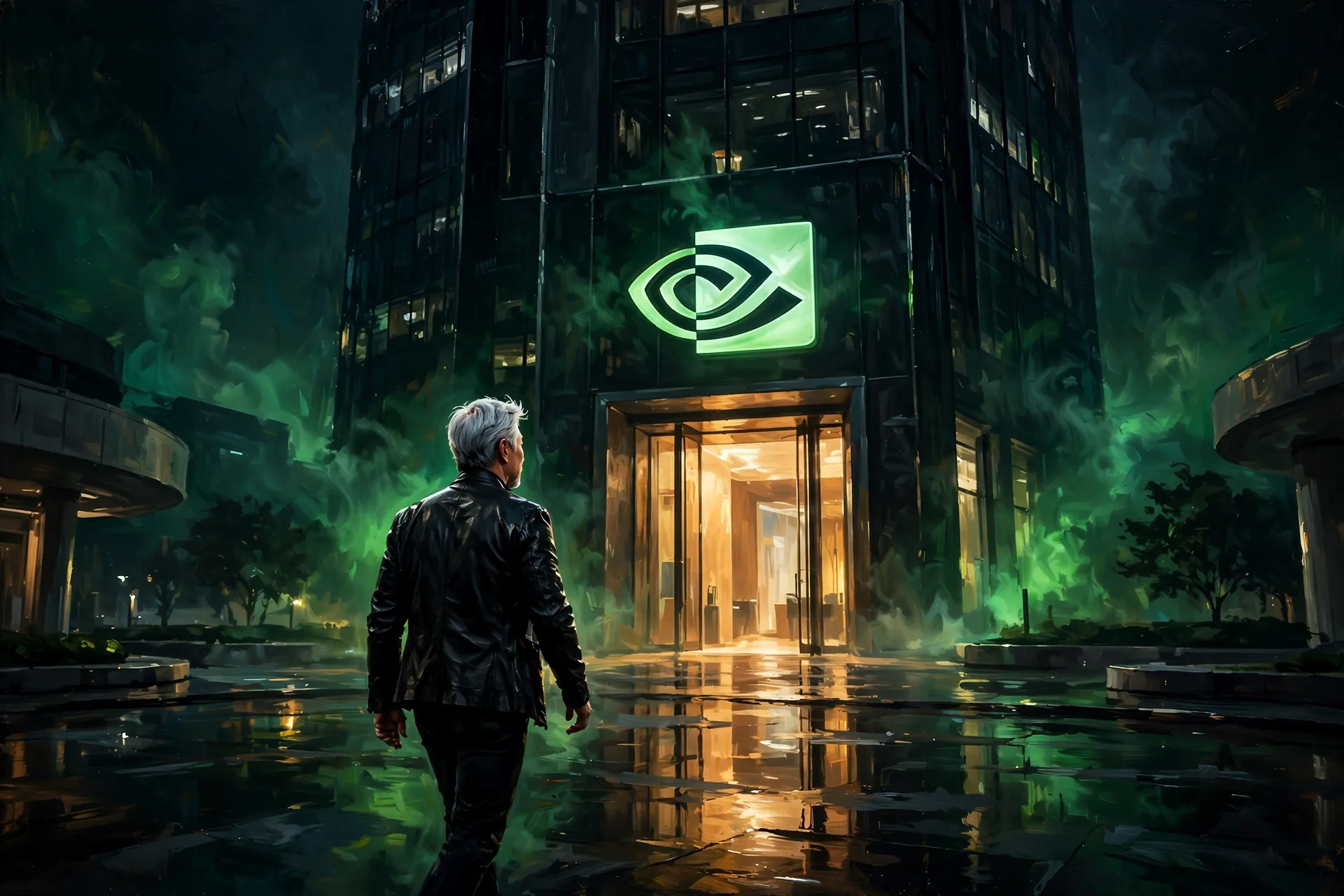
In April 1993, three engineers sat in a booth at a Denny's on Berryessa Road in East San Jose and sketched a chip company: Jensen Huang, Chris Malachowsky, and Curtis Priem. NVIDIA was incorporated on April 5, 1993. As a teenager in Oregon, Huang had worked graveyard shifts at a Denny's, as dishwasher, busboy, and waiter.
He became CEO on day one, at thirty years old, and for 33 years and 7 months he never stopped. NVIDIA had exactly one chief executive, and the longest single run at the top of a major technology company in the modern era ended last week, in seven days, over a letter, a report, and a board meeting held after dark.
Four days later, the campaign to bring him back existed in public: an investor letter, a petition past 150,000 names, a reported war room, and a Treasury secretary demanding the opposite. The question is no longer why Jensen Huang left. It is whether NVIDIA can keep him out.
Thirty days from going out of business
Huang's authority was never just the title. It was earned at the moments when being wrong meant closing the doors.
The first chip, the NV1, failed: it bet on quadrilaterals while the industry standardized on triangles and Microsoft's DirectX. Then came the moment that made his reputation. NVIDIA was under contract to build Sega's next console chip, and Huang concluded it could not meet Sega's needs. He flew to Japan to tell Sega's president, Shoichiro Irimajiri, exactly that. Irimajiri instead persuaded Sega to invest $5 million in NVIDIA anyway. Huang has called that money the lifeline. He cut his staff from about 100 people to about 40 and bet the company on one conventional, DirectX-compatible chip: the RIVA 128, shipped in August 1997, sold about a million units in four months, with about one month of payroll left in the bank, by his retelling. His line from those years became the company motto: "Our company is thirty days from going out of business."
Then came the bet that built the modern company: CUDA, launched in 2006, opening the graphics chip to general-purpose computing at a reported cost in the hundreds of millions. It built the developer ecosystem the entire AI industry now runs on. The milestones followed: $1 trillion in 2023, the first company ever to $4 trillion in July 2025, and the first to $5 trillion on October 29, 2025.
The black leather jacket became a corporate logo in human form. And succession? In 33 years, NVIDIA never publicly named a successor or a formal succession plan. At CES in January 2026, asked how long he would remain CEO, Huang said: "The secret for being CEO for this long is 1) don't get fired and 2) don't get bored. How long? For as long as I deserve it." As reported from his Lex Fridman podcast appearance this year, he said he never believed in succession planning and hoped to die at his desk. Four weeks later, he was out.
Seven days in November
The week started with an intelligence story, not a product failure or a bad number.
On October 29, The New York Times reported that U.S. intelligence officials had assessed that Alice Huang, a former executive at Megaspeed, a Singapore-based NVIDIA customer, was gathering information for Beijing and had been recruited by China's Ministry of State Security, and that Jensen Huang had a personal relationship with her. The two are not related.
On Sunday, November 8, Huang answered in a published letter: "I was unfaithful to my wife. There is no excuse for what I did. I am deeply sorry." The same day, NVIDIA's board announced an independent investigation into reports that Huang "has been the target of a foreign intelligence effort." The board said it had "no reason to believe that either national security or NVIDIA secrets were compromised," and it expressed confidence in Huang.
On Tuesday, the independent directors were reported to have retained Wachtell, Lipton, Rosen and Katz and former acting U.S. Attorney Joon H. Kim to run the inquiry. On Wednesday, November 11, the Times reported a second relationship: Huang and Kimberly Powell, NVIDIA's vice president of healthcare, a direct report of his, citing five former employees. Huang has not publicly confirmed that report. After the close, The Wall Street Journal reported the board was preparing to remove him. The board met that night and accepted his resignation as president, chief executive officer, and director, effective immediately.
NVIDIA's press release and its Form 8-K filing with the SEC say he resigned. Neither document gives a reason. What the record supports, and what this piece will say, is that Jensen Huang resigned under board pressure, with the board, by the Journal's reporting, prepared to remove him if he had not.
On Thursday, NVIDIA announced the transition. Colette Kress, the chief financial officer, became interim CEO while keeping the CFO job. Harvey C. Jones became the company's first-ever Chair of the Board.
The market said plenty. NVIDIA had closed at a record $239.24 on October 6. By the November 11 close it was $173.73. On November 12 it opened at $151.01, down 13.1 percent, and recovered to close at $166.19. Friday's close was $162.85. For the week of November 9 to 13, the stock fell 12.8 percent while the S&P 500 rose 2.5 percent and rivals AMD and Broadcom rose 18.9 and 18.2 percent.
Before the exit, Dan Ives had called Huang "irreplaceable" and estimated a departure could take the stock down 25 to 30 percent. The worst of the actual first trade was 13 to 14 percent down, half of it back by the close. The market was frightened. It was not, yet, convinced the company was broken.
What the secrets question actually is
Here is what is alleged, all of it reported, none of it adjudicated, because the loudest version of this story is not the supported one.
First, the intelligence allegation. U.S. intelligence officials assessed that Alice Huang was recruited by China's Ministry of State Security to collect information about America's AI chips, and that Jensen Huang was the target of a foreign intelligence effort. Note the direction: as reported, he was the target, not an accused agent.
Second, the export-control thread. Megaspeed, a Singapore cloud company, bought a reported $4.8 billion or more of NVIDIA hardware over two years. It is under U.S. investigation, first by the Commerce Department and then, by reporting, by the Justice Department, over whether its NVIDIA chips were diverted to China in breach of export rules. Megaspeed denies illegal exports and says six months of on-site inspections by U.S. export-control officials, Malaysia's trade ministry, and NVIDIA found no violations. No charges against Megaspeed or Alice Huang have been announced.
Third, the candor thread. Reuters reported on November 13, citing sources and internal correspondence, that in October Huang told general counsel Tim Teter and other leaders that his interactions with Alice Huang were standard customer dealings. Georgetown's Jason Schloetzer told Fortune: "Boards remove CEOs over candor issues. What did he tell the directors, and when?"
Now what is established. Huang admitted marital infidelity, in writing, on November 8, and pledged full cooperation with the investigation. He has not admitted espionage or disclosing confidential information, and no public evidence establishes either. The board's November 8 position, quoted above, is preliminary, not a final finding: the investigation is ongoing, with no published findings and no timeline. NVIDIA previously described Megaspeed as a regional cloud customer that received ordinary commercial information. Huang has not been charged by any country.
The candor question is already in a courtroom: a proposed securities class action, Kistenmacher v. NVIDIA, filed November 9 in federal court in California, alleges NVIDIA's Megaspeed statements were materially false and misleading because they omitted the relationship. It is an allegation, untested, no class certified, no wrongdoing admitted or found.
Four days
The return campaign took four days to form, in three parts the weekend's coverage kept blurring into one.
The first part is a letter from money. On Friday, November 13, Brad Gerstner of Altimeter Capital and Gavin Baker of Atreides Management published an open letter. It does not demand Huang back. It asks the directors to "pursue a slow, measured, and deliberate process regarding the future leadership of Nvidia that leaves all options on the table, including the potential return of Jensen Huang." It says Kress will capably lead in the meantime and concedes the final call is the board's. The proportion matters: in their most recent filings, dated June 30, the two funds held about 10.7 million NVIDIA shares between them, roughly four-hundredths of one percent of the shares outstanding. The letter's weight is not votes; it is reputation, aimed at ten directors, in public.
The second part is a petition, and a petition is a list of names, not a measurement. The "Stand with Jensen" campaign, run by organizers unaffiliated with NVIDIA or Huang, by their own account, asks the board to reinstate him while the investigation establishes the facts. Its counter passed 150,000 on Sunday, with organizers claiming more than 160,000 by Sunday's end. Elon Musk signed, and said so on X on Friday: "A petition is underway to reinstate Jensen and I'm signing it too." The site says thousands of signers are current employees and tens of thousands are shareholders, and in the same breath that every affiliation is self-reported and unverified. Fake entries appeared, including "Tim Cruise, Hollywood actor" and "Xi Jingping," and the organizers said on Saturday they were working to remove them.
Inside the company, the genuine signal is quieter: Wired reported an internal forum post by a longtime engineer, written before the resignation, urging the board to weigh employee views; it drew more than 1,600 comments, several calling for Huang's return. A comment count, not a headcount. The weekend also produced a forged letter claiming senior executives had demanded the board's resignation and Huang's return. Bryan Catanzaro, listed as a signatory, answered on X: "This letter is obviously fake, and even if it were real I would not sign it." He backed the board and Kress in the same breath.
The third part is the man himself. On Sunday, November 15, the Financial Times reported, citing people familiar with the matter, that Huang has discussed a return with close confidants. One ally told the paper that a "war room" of Silicon Valley executives is being assembled to lobby the board and seek White House backing, and that the effort has Huang's support. NVIDIA and a spokesperson for Huang declined to comment. Nothing in the reporting says the board has engaged or moved. Its only word on the search, on November 13: still selecting a search firm, no candidate formally engaged. The FT also reported that the board has approached Arm's chief executive, Rene Haas, as a possible successor. Reuters could not verify that report.
The pushback came the same weekend. On Sunday, Treasury Secretary Scott Bessent told Fox News the board should "go outside the company" for its next leader: "they need a dramatic shakeup." His subject was compliance culture: "I want to keep coming back to what was the culture at Nvidia, and were they pressing these seemingly illicit sales to goose their revenues and their earnings?" Bessent wants answers from the board and its outside counsel within ten days. Those are questions, not findings; no agency has announced a charge. And Ives told Newsweek on Sunday: "Despite pressure from major shareholders we see no chance Jensen comes back to Nvidia as CEO."
The door, and the gates in front of it
He did not just walk out. Getting back in is work, and the work has a shape.
The mechanics are simple. Under NVIDIA's bylaws, a majority of the directors in office can remove or appoint an officer at any time, with or without cause. A return as CEO needs six of the ten directors. There is only a board vote. The board seat is a separate door, and Huang closed it behind him: he resigned as a director too, and getting it back takes appointment by the board or election by shareholders, with the next annual meeting in 2027. His remaining leverage is his stake, about 3.58 percent of the company (870.6 million shares), nowhere near control, plus performance. The interim structure keeps the door open: Kress is explicitly interim, double-hatted as CFO, and the board has set no search timetable. The day a permanent CEO is named, the six-month scenario effectively dies.
In front of any vote stand four gates: the investigation's findings, clean or narrow; the Justice Department's Megaspeed track, with no charge touching Huang personally; his congressional appearances in early December, without a defining bad moment; and the test of running the company without him, starting with the third-quarter earnings call on Tuesday, November 17. If Kress steadies the stock and the roadmap, the board's incentive to reopen a scandal shrinks; if execution wobbles, it grows.
History does not argue for fast. Jobs was pushed out of Apple in 1985 in a power struggle, and he did not come back because the board missed him: Apple, near bankruptcy, bought his company, NeXT, in December 1996 for about $429 million, and Jobs with it. Eleven to twelve years, out and back. Huang has no NeXT to sell NVIDIA. The closer modern template is Sam Altman at OpenAI in November 2023, removed over candor, in his board's words "not consistently candid in his communications," and reinstated five days later after 745 of roughly 770 employees threatened to quit. But even that return required the board itself to be replaced. The other founder returns took years, not months.
The counterweight is just as clear. Chief executives who left under conduct clouds, Kalanick at Uber, Schnatter at Papa John's, and the relationship-scandal CEOs at Intel, McDonald's, BP, and Nestlé, never returned. Not one. Every successful comeback on the record followed a business failure by the successors, not a vindication of the founder.
So a return by roughly May 2027 is mechanically possible. It would also be the fastest founder restoration of this scale on record, and it requires two things at once: the investigation clears him, and the interim period disappoints. The campaign compressed the asking into four days. It did not move a single gate.
The prediction
What follows is a prediction, named and owned as one.
Shane Sharnock, a friend of this studio, predicts that Jensen Huang will be back at the helm of NVIDIA within about six months, by roughly May 2027. His reasoning: run the company without him, and the board and the market will learn what he was worth. It is a prediction, not reporting, with no sources behind it other than the man making it.
Brad Frederick, chairman of Frederick Studios, agrees in full. That agreement is the publisher's view, labeled here as exactly that: opinion, not a conclusion the reporting above compels. The record argues both ways.
Three dates will test it: the investigation's findings, Huang's congressional appearances requested for December 1 and December 3, and the earnings calls starting Tuesday, November 17. Those three tests will prove the prediction or kill it, in public.
The company began in a Denny's booth, built by a man who spent 33 years refusing to accept the end of the story. Now the fight is a board vote, four gates in front of it, and a campaign that formed in four days.
You cannot get rid of Jensen. The question is whether NVIDIA's board will let him back in.
Reporting in this piece is drawn from NVIDIA's press release and SEC filings, the company's published statements, a federal court filing in the Northern District of California, and reporting by The New York Times, The Wall Street Journal, Reuters, the Financial Times, CNBC, Bloomberg, Business Insider, TechCrunch, Wired, Newsweek, and the AP, as graded in this studio's research files. Where a fact is reported rather than confirmed, the piece says so in line.
Solutions, not problems. Proof, not promises.