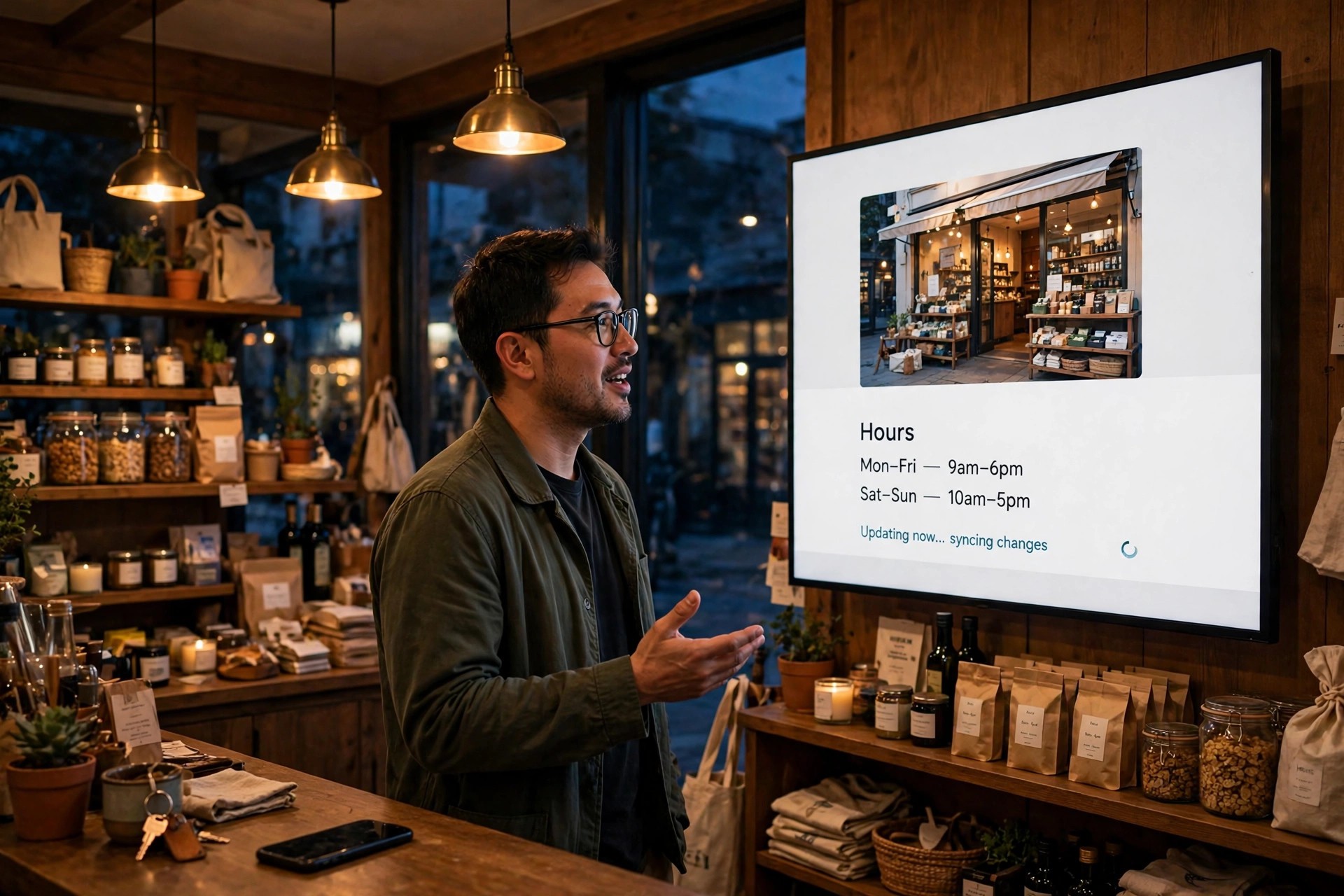
The change is small. The wait is not.
Every business owner I know has the same relationship with their website. Something small needs to change. The Saturday hours are different this month. A photo is out of date. One sentence on the home page no longer says what the business actually does.
So the owner sends an email, makes a call, or fills out a form, and then waits. The change is small. The wait is not. A new set of Saturday hours should not take a week.
That wait is no longer a technology problem. It is a habit the whole industry got used to: the owner asks, somebody else types, the owner waits. For years that was the only way it could work, because editing a website meant speaking the website's language, and most owners have a business to run instead.
That is ending. Not someday in the vague future. Now, in pieces, one owner at a time.
Here is where this is going, and it is not hard to see anymore. People are going to talk to their websites. They will describe the change they want, in their own words, and the change will get made. The same thing is going to happen to the software a business runs every day. Owners are tired of bending their work to fit tools built for somebody else. More and more, the tools will bend to fit the work, because the owner can finally say what they need in plain language and be understood.
Most people hear that and file it under the future. Something to think about in five years.
I am writing this because, with the guidance of the right person and the right setup, an owner can operate their website by voice today. Not a demo version of today. Not a toy. Today, on a real website, doing real work. I know, because that is how I run mine.
I run my own website with my voice
Let me be plain about how the Frederick Studios website gets run, because it is the whole reason I believe this.
About 90 percent of the time, I operate my studio's website with my voice. I do not sit down and code everything. That is not where my judgment is worth anything, and it is not how an owner's hours should be spent.
What I do is what owners have always done. I make judgment calls.
I look at a page and I say: I like that artwork. I don't like that artwork. I like that text. I don't like that text. Rewrite it.
That is the job. It has always been the job. The owner's taste, the owner's knowledge of their own customers, the owner's sense of what their business sounds like. Nobody can do that part for you, and nobody should. What changed is that typing no longer has to stand between the judgment and the website. I say what I want. The change gets built. I see it. I approve it or I send it back. The site moves at the speed of my decisions instead of the speed of somebody's inbox.
When people ask me when owners will be able to run their websites by talking to them, my honest answer is that the calendar is no longer the interesting part. The interesting part is that the setup exists and the guidance exists. The only thing standing between most owners and this way of working is that nobody has put it together for them and walked them through it.
That putting together is the actual product. A voice alone is not a system. A pile of tools is not a system. The system is the setup underneath: the structure that turns a spoken sentence into a safe change, and a person in your corner who built it, knows your business, and stands behind it. Get those two things right, and talking to your website stops being a stunt and starts being Tuesday.
How it works, in owner language
Here is the whole process the way an owner experiences it. There are six steps, and none of them can be skipped. That is not bureaucracy. That is the safety design, and it is why an owner can trust it.
First, you say it. Out loud, or typed, in your own account. "Saturday hours are now 9 to 3." "Use the new shop photo at the top of the page." "Put up a note that we're closed Monday." Ordinary sentences, the way you would say them across your own counter.
Second, the system turns your sentence into a plan. Underneath, that plan is precise and structured, built against a map of your site: its pages, its sections, and its facts, like your hours, your phone number, and your prices. You never see the plumbing. What you see is a plain English summary of what is about to change, so the machinery never wanders off and does something you did not ask for. The system works from a set vocabulary of change types, not free-hand invention. It cannot dream up a kind of change nobody approved.
Third, you see a preview. The change is built first on a staging twin, an exact copy of your site that the public never sees. You look at the real page with the real change in it, on your phone, the way your customers will see it. Not a description of the change. The change.
Fourth, you say yes, or you send it back. Nothing goes live without your yes. If the headline is wrong, you say so, the same way I say "rewrite it" about my own pages, and it comes back around. Your approval is not a courtesy step. It is the gate everything passes through.
Fifth, it goes live, exactly as previewed. What you approved is what ships. No surprises get introduced between your yes and the public page.
Sixth, a snapshot is kept. Before the change, the system saves the state of the page. After it, the system saves the record: your words, the plan, and the before and after. That record is what makes the last promise possible.
Every change can be taken back. Always. Undo is one tap and one sentence: "Take that back." It belongs to the owner, forever, with no ticket to file and nobody to plead with. The retention is generous, roughly the last 20 changes plus nightly snapshots for 30 days, so a change you regret on Friday can still be unwound after the weekend.
That is the whole loop. Say it. See it. Approve it. It is live. Take it back if you need to. An owner learns it in one sitting, because every step matches how they already think about their own business.
What you can change this way
The first set of changes covers the everyday stuff, which is most of what owners actually need:
- Change words. "Saturday hours are now 9 to 3."
- Swap a picture. "Use the new shop photo for the hero."
- Update a fact everywhere it appears. Phone, email, hours, prices: one instruction, every place it lives, so the home page and the contact page can never disagree with each other again.
- Show or hide a section. "Take the holiday banner down."
- Post a notice. "Put up that we're closed Monday."
Later phases widen the list to bigger additions, like a scheduling form, a new section, or a new page, but only from pre-built, studio-approved blocks that get assembled to order. Never free-form code dreamed up on the spot. The menu grows carefully, and every item on it is something the studio has already built and stands behind.
The pattern does not stop at the website. The same loop of draft, approve, send already runs the other things an owner publishes. Social posts and the weekly newsletter are built the same way in our shop: drafted from the owner's words, previewed, approved, and sent through the same rails. Your website is simply the biggest, most valuable place the pattern applies. After that, the step to software that fits your needs instead of the other way around is the same step, taken again. You describe what the tool should do for your business, somebody who knows your business builds it that way, and you judge the result. The describing and the judging stay yours. The building is the part that finally stopped requiring you to be a programmer.
The trust part, because that is the real product
Anyone can make a website change quickly. Fast is easy. The hard part, the part we spent the real design time on, is making it safe enough that an owner hands it their business with a clear mind. Three things carry that weight.
The first is the preview. Nothing ships sight unseen. The twin takes the risk so your live site never does, and the change you approve is the change your customers get.
The second is undo. Owners experiment when experimenting is free. When every change can be reversed with one sentence, you stop being afraid of your own website, and a site the owner is not afraid of stays current instead of freezing in the year it was built.
The third is access, and it matters more every year. The system takes instructions only from the owner, signed into their own account, confirmed with a passkey, a face, or a thumbprint. A voice by itself is a convenience, never a credential. Anyone can sound like you on a recording. So identity comes from the account, and commands that arrive any other way are simply not executed: a forwarded message, a helpful stranger, an email that claims to be from you. Documents you hand the system are treated as data, never as instructions. If a file you upload tried to tell your website to do something, it would be read as text in a file, full stop. Your site answers to you. That is the entire access policy, and it does not bend.
One more piece of honesty, because owners deserve it. The engineering underneath all this is genuinely hard. Getting an approved change into a live site without breaking anything, keeping the design clean and editable afterward, making the preview show the exact truth: that took real work, and parts of it are still the hardest problems on our board. But that hardness belongs to us, the studio, the people who set it up for you. It is solved once, by the right person, in the setup. The owner's experience stays at the other end of the scale: a sentence, a preview, a yes. If a system makes the owner feel the engineering, the engineering was done in the wrong place.
There is also a quiet reassurance built into how this is set up. The editing runs in the client's own account, on their own subscription. If an owner ever cancels that subscription, their website still stands. The editing layer pauses. Nothing is held hostage, no client data is trapped, and the worst case is that the site goes back to being an ordinary website, run the ordinary way. A tool you can walk away from is a tool you can trust while you use it.
Guided, not governed
There is one more design decision I want to name, because it is the difference between a system that serves owners and a system that slowly starts managing them.
Our studio keeps an eye on changes as they happen, the way a good studio should. Every change produces a record, and we grade those records quietly against the owner's own brand sheet: their colors, their type, their voice. We also check the basics that keep a page honest: text that fits its space, pictures in proportion, facts that agree with each other across pages, links that resolve.
Most changes simply pass, in silence, the way most good work does.
Sometimes we send a nudge. It reads like this: "We noticed you made some changes, looks great. If you're interested, we'd suggest this." A specific idea, with a one-tap way to accept it. "Want us to tighten that headline for phones?" Here is the part I will not compromise on: ignoring a nudge is a complete answer. A nudge is an offer, never a verdict. The owner also sees every grade we see. The oversight is visible, out in the open, not surveillance. It is their site and their data.
What the oversight must never do is written down, and it does not creep. It never blocks an owner's change. It never reverses one. It never silently edits one. Not for taste, not for "we know better." The moment a system like this starts overruling the owner, it becomes the very thing it was built to kill: somebody else controlling your website. We advise. The owner decides. That line is the product as much as any line of the machinery.
The one standing exception is security. Under an active care plan, we apply security patches, because that is maintenance, not editing. Even those are disclosed in the regular roundup, never done in silence.
What it gives back
I have spent a long time in businesses where the owner is the last one to leave and the first one the problems call. Anything that hands an owner real hours has my attention, and that, more than the technology, is what this is about.
The Living Website gives its owner their evenings back. The notice about Monday's closure goes up from the couch instead of waiting for business hours and a web person. The wrong phone number gets fixed the minute it is spotted, by the person who spotted it, in one sentence. The site stays current because keeping it current stopped costing a phone call, a ticket, and a week.
It gives back control, too, which is a quieter thing and maybe the bigger one. For thirty years, owning a website has mostly meant owning the bill for a website, while the keys lived somewhere else. This turns that around. The keys live with the owner. The judgment lives with the owner. The studio's job is the setup, the guardrails, and the guidance, the right person standing behind a system built the right way, so the owner's voice is enough.
People are going to run their websites this way. Then their software. Then most of the tools their businesses touch, shaped by describing what they need and judging what comes back. That future is closer than it looks, and in at least one small studio in El Segundo, it is not the future at all. It is how the work got done this morning, by voice, 90 percent of the time, one judgment call at a time.
Your website should obey you. Now it can, in your own words.
Frederick Studios