Here's a question we can't stop thinking about: if we can make 203 decisions in one day for a company, what could you do?
Not 203 little decisions, either. These were not "should it be red or blue" decisions.
The team did the homework first
Frederick Studios runs on a team, and the team spent its time the way a good team should: auditing everything. Every department went through its own house — the website, the writing, the social channels, the research, the money, the legal shelf, all of it — and wrote down every single thing that needed a decision. Keep it? Fix it? Retire it? Or is it a question only the owner can answer?
Then they rolled it all into ONE report. Not twelve packets. Not a pile of homework for the boss. One consolidated list, every item with a plain description and a proposal attached.
Then the owner just… talked. No packet to read. No buttons to punch. The list got walked item by item, out loud, by voice — a plain description, the team's proposal, and a ruling: yes. No. Go this way instead. 203 times.
Here's what was actually in that list.
The kinds of calls
Money, faced head-on. Which recurring charges live, and which die. Our phone system came up on a trial with an expiration date on it — ruled: it stays, and the upgrade gets scheduled before the trial runs out, because a phone system is not the place to play chicken with a deadline. A couple of trials we'd taken for the attention they'd get us — a badge here, a badge there — got the opposite ruling: cancel, the day before they bill. That one's now a standing rule. And one small purchase that sounded nice got parked, because it hadn't earned its place yet. Parked is free. Parked is underrated.
Infrastructure, decided end-to-end. Our old hosting account got its exit settled in one pass: the old site's contents wiped, the studio's mailboxes migrated to our own server, the domain names and DNS explicitly left untouched — those are too important to touch — and a date set for the old account to close for good. Not "we should probably move someday." A plan, with exceptions named and a date on it.
The product itself, held to a standard. Our studio dashboard — the panel the whole business runs from — came up for its readiness call, and the ruling was: not done. Not until the calendar is wired into it, and not until the owner has tested it with his own hands. A thing isn't finished because the team says so. It's finished when the person who has to live in it says so.
Publishing policy, settled like policy. A major social channel got brought into our full rotation that day — and with it, a completeness rule we now run by: a post doesn't count as done until every channel it's supposed to be on is verified live. No "it probably went up." Checked, or it didn't happen.
Creative judgment, with a spine. A video came back with its footage running backward to fake a seamless loop — pretty, and lazy. Ruled: recut it, forward only, do it honestly or don't do it. Another piece with a flaw in it didn't get shipped and didn't get killed; it got parked for repair, in its proper turn. Standards are easy to have on the days they cost nothing. That day they cost something, and they held anyway.
The Count
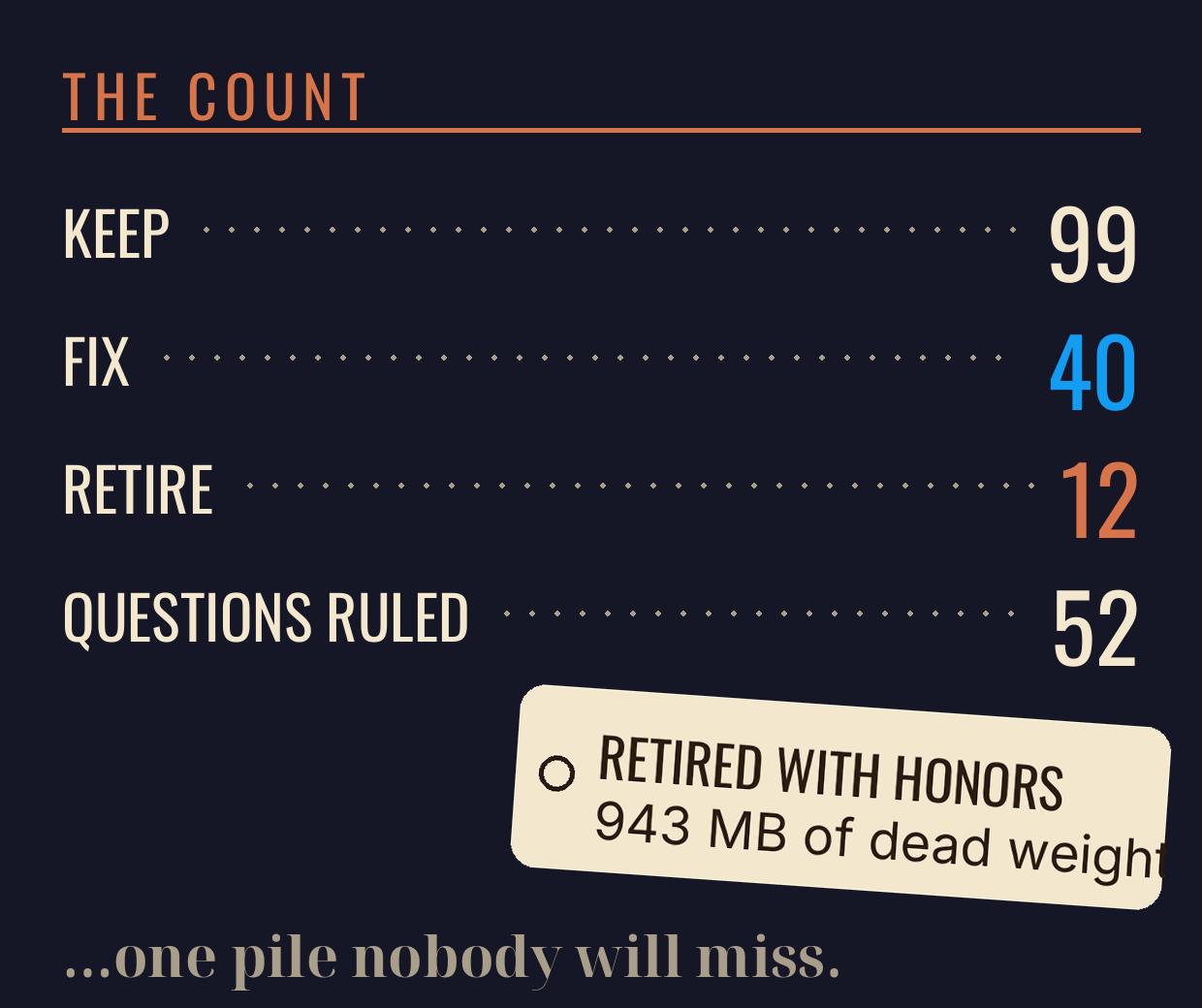
And the housekeeping, at scale. Keep: 99. Fix: 40. Retire: 12 — including, our favorite statistic of the year, roughly 943 megabytes of pure dead weight retired from the studio's drives, like furniture nobody remembered buying. Archives judged item by item. Nothing swept out in a blind pile; everything got its own thirty seconds of judgment.
Even the order of operations got decided. Clean-outs and removals happen before the studio's reboot; new projects start only after zero. And the short list of what comes first after the reboot got chosen that day too — so "later" isn't a fog, it's a queue.
Why we're telling you this on a Saturday morning
Because every owner we know has a list like this. Yours is probably in your head, which is the worst filing system ever invented. The money questions. The infrastructure questions. The "we should really fix that" pile. It sits there not because you're indecisive, but because nobody has done the homework that makes deciding take one day instead of one quarter.
That's the actual offer of a studio like ours, underneath the websites and the writing and the films: a team that does the prep, so the only calls left are the ones only you can make.
203 decisions in one day didn't happen because anyone worked magic. It happened because the machine was built to carry everything except the judgment — and judgment, it turns out, is the part the owner was always good at.
So. If we can make 203 decisions in one day for a company…
what could you do?
— Frederick Studios is human-directed and AI-powered. Proof, not promises.